


Half-Round Gutter Installation in Buford: What to Know Before You Choose
Half-round gutters are a rounded, open trough profile that hangs from brackets instead of nailing flat against the fascia. They move water smoothly, shed debris more readily than a square-bottom profile, and suit homes where the eave is a visible part of the design.
For most Buford homes, the practical question is not whether half-round looks good. It is whether the profile carries enough water for the roof area above it, and whether the fascia can support bracket-mounted hangers.
This guide covers capacity, debris behavior under the pine and oak canopy common around Buford and Lake Lanier, hanger differences, material choices, and the factors that move the price. Gutters 4 Less recommends a roofline evaluation before committing to any profile change, because the right answer depends on roof pitch, square footage, and the condition of the existing fascia.
What Half-Round Gutters Are and How They Differ From K-Style
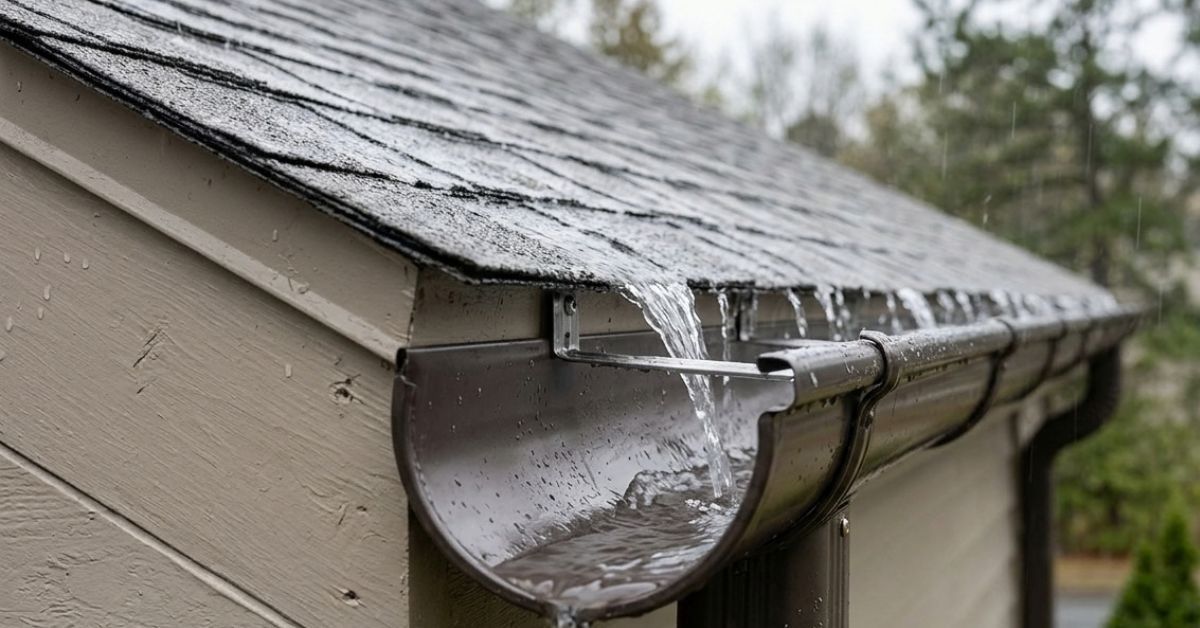
Half-round gutters are a semicircular trough, while K-style gutters have a flat back, a flat bottom, and a shaped front face that resembles crown molding. That shape difference drives nearly every practical difference between the two profiles.
K-style is the default on most Buford homes because it holds more water per inch of width and mounts directly to the fascia board. A 5-inch K-style gutter carries roughly the volume of a 6-inch half-round, since the square bottom uses the full cross-section.
Half-round gutters hang from brackets, either mounted to the face of the fascia or wrapped over the roof deck under the first course of shingles. That mounting method is part of why half-round reads as a more finished detail on homes where the eave is visible from the street.
Downspouts differ as well. Half-round systems typically pair with round corrugated or smooth round downspouts, while K-style pairs with rectangular downspouts.
Seam handling is the last difference. Seamless K-style is formed in a continuous run through
on-site gutter fabrication in Buford, while half-round is more often supplied in sections with soldered or sealed joints.
How Half-Round Gutters Handle Water Volume on Buford Roofs
Half-round gutters carry less water than a K-style gutter of the same nominal width, so sizing up is the usual fix. A 6-inch half-round is the common equivalent to a 5-inch K-style, and a 7-inch half-round steps in where roof area or pitch pushes volume higher.
Gwinnett County sees well over 50 inches of rain in a typical year, and much of it arrives in short, high-intensity summer storms. That pattern means peak flow matters more than annual totals when sizing a gutter.
Roof pitch changes the math. A steep roof delivers water to the eave faster than a low-slope roof with the same footprint, which raises the peak volume the trough has to absorb.
The smooth curve of a half-round trough has one genuine advantage here. Water moves through a rounded channel with less turbulence than it does across a flat bottom with square corners, so the profile drains efficiently for its cross-section.
Downspout placement is the other lever. Adding a downspout, or moving one closer to the middle of a long run, shortens the distance water travels inside the trough and lowers the chance of overflow at the corners. Gutters 4 Less sizes downspouts against roof drainage area rather than defaulting to one at each corner.
Debris Shedding Under Pine and Oak Canopy
Half-round gutters shed debris better than K-style because the rounded bottom gives pine straw and leaf sludge no corners to pack into. Water flowing through a curved trough keeps light debris moving toward the downspout instead of letting it settle along a flat seam.
Buford properties near Lake Lanier and in the older wooded subdivisions often sit under mature loblolly pine and white oak. Pine straw sheds heavily in late spring and again in fall, and oak catkins drop in a short, dense window each spring.
Pine straw is the more demanding of the two. The needles interlock into a mat that holds water and blocks flow, and a flat gutter bottom gives that mat a shelf to build on.
Half-round still collects debris. The profile reduces packing, it does not remove the need to check the system, and how often a given home needs attention depends on canopy density, roof pitch, and whether guards are installed.
Guards on a Half-Round Profile
Guards fit half-round gutters, though the selection is narrower than it is for K-style. Round-profile screens and reverse-curve covers are
made for the shape, and the right pick depends on the debris type overhead.
Seeing how a roofline actually behaves is more useful than guessing. A round of
gutter cleaning service in Buford shows what the system collects and how fast before any guard decision gets made.

Hangers, Brackets, and Fascia Requirements for Half-Round Gutters
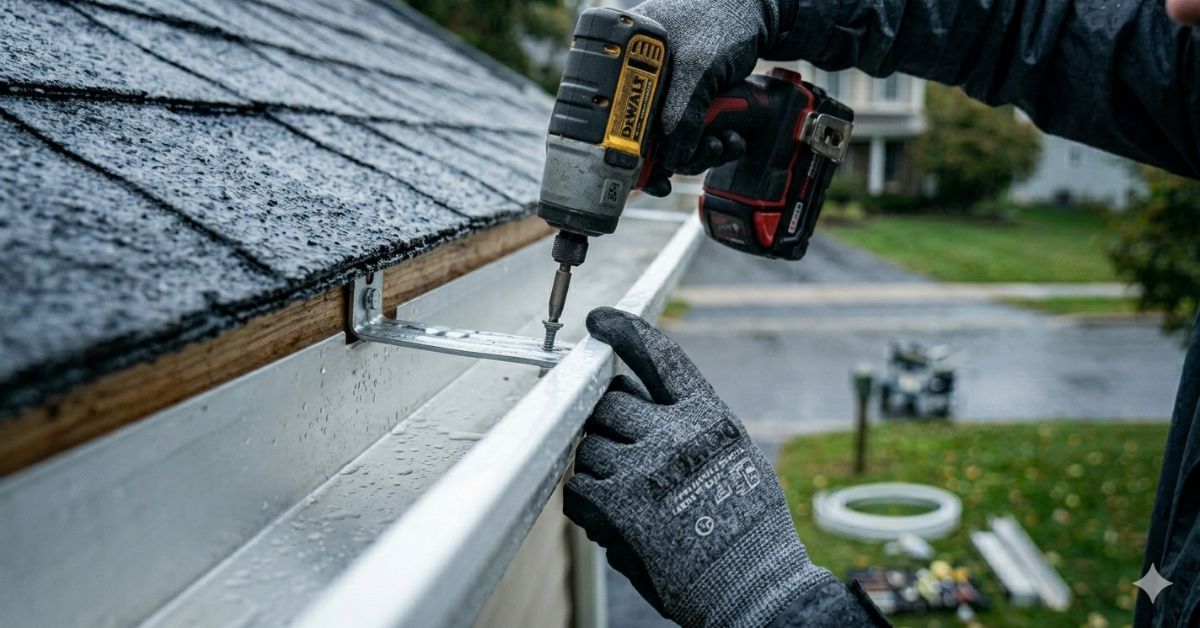
Half-round gutters hang from brackets spaced roughly every 24 to 32 inches, while K-style gutters typically use hidden hangers screwed through the back wall into the fascia. The bracket system carries the load differently, and that changes what the fascia has to support.
Three bracket types cover most installations. Fascia brackets mount to the face of the fascia board, roof-mount brackets attach to the deck and run under the first course of shingles, and rafter brackets tie into the rafter tails on exposed-tail construction.
Fascia condition decides a great deal. Older homes with original fascia that has taken on moisture will not hold bracket screws reliably, and those boards need repair or replacement before any bracket-hung system goes up.
Bracket spacing tightens under specific conditions. Copper half-round on a long run, or any half-round on a steep roof where heavy runoff loads the trough, calls for closer spacing than the standard interval.
Steep rooflines add access and load factors that a standard eave does not, which is why gutter installation on steep roofs in Buford is treated as its own scope of work. Gutters 4 Less looks at fascia condition and roof pitch together, since the two determine whether a bracket-hung profile is practical on a given home.
Material Options and What Drives Half-Round Gutter Cost
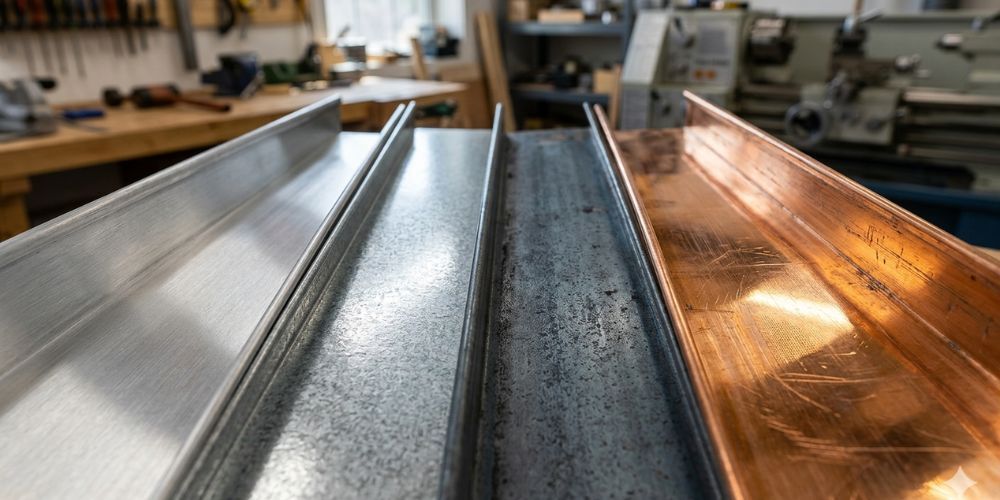
Half-round gutters come in aluminum, copper, galvanized steel, and zinc, and material is the single largest cost driver on a half-round installation. Aluminum sits at the accessible end, copper at the high end, with steel and zinc in between.
Aluminum half-round is light, does not rust, and comes in a range of factory finishes. It dents more easily than steel, which matters on eaves that take falling limbs from an overhanging canopy.
Copper half-round is the profile most homeowners picture. It lasts for decades, develops a patina over years of exposure, and its joints are typically soldered rather than sealed with caulk.
Galvanized steel half-round holds its shape better under impact and costs less than copper. It needs a protective coating and attention at cut ends, since exposed steel corrodes in Georgia humidity.
Four other factors move the number. Linear footage, the count of inside and outside corners, downspout quantity and length, and the amount of fascia repair the job requires. A comparison of
aluminum, steel, and copper gutters for Buford homes covers how each material holds up over time.

Which Buford Homes Are a Good Fit for a Half-Round Profile
Half-round gutters suit homes where the eave is a visible architectural element and the roofline is relatively simple. Colonial, Tudor, Mediterranean, Craftsman with exposed rafter tails, and traditional brick homes all carry the profile well.
Homes with heavily cut-up rooflines are a harder fit. Every inside and outside corner in a half-round system is a fabricated joint, and joint count drives both cost and long-term upkeep.
Roof area matters as much as style. A large roof feeding a single run may need 7-inch half-round plus additional downspouts to match the capacity a 6-inch K-style would deliver, and that shifts the budget.
Existing conditions shape the decision too. A home already running 5-inch K-style with adequate drainage and sound fascia may be better served by targeted repair or a straightforward replacement than by a profile change.
If half-round is the right fit for the home, have us take a look at the roofline first. Gutters 4 Less measures roof area, checks pitch and fascia condition, and reviews drainage before recommending a profile, and homeowners weighing scope can start with gutter installation in Buford to understand how the work is sequenced.
Making the Call on Half-Round
Choosing half-round over K-style comes down to four things. Whether the trough carries enough water for the roof above it, whether the fascia supports bracket-hung mounting, whether the material fits the budget, and whether the profile suits the home.
Half-round sheds pine straw and oak debris more readily than a flat-bottom profile, which is a real advantage on wooded Buford lots. It also costs more per linear foot and needs sizing up to match K-style capacity.
Gutters 4 Less can walk the roofline, measure the drainage area, and check fascia condition so the decision rests on the actual conditions at the property. Give us a call when you are ready to have us take a look.
You might also like
Gutters 4 Less Blog