


Builder-Grade Gutters on Newer Cumming Homes: When an Upgrade Makes Sense
A lot of the newer homes we see around Cumming went up fast. The gutters got installed on the builder's schedule, often the same week as a dozen other houses on the street.
They usually do fine for a few years. Then one day water spills over a corner, or a section starts pulling away from the fascia, and you start wondering if the whole thing needs to go.
Sometimes it does, sometimes it doesn't. At Gutters 4 Less we check the metal, the fasteners, the outlets and the roof edge, and then we tell you which parts are fine and which ones won't last.
What Builder-Grade Gutters Usually Look Like
"Builder-grade" just means the basic package a builder puts on a lot of homes to meet the plan and stay on budget. It isn't one product, so two houses on the same street can have pretty different setups.
Most of the time you'll find thinner aluminum, basic fasteners, the fewest downspouts the plan allows, and not much detail at the roof edge.
None of that is a defect by itself. Add it all up, though, and there isn't much cushion left for the rain and leaves a Cumming house gets.
Signs of a Builder-Grade Gutter Install on Cumming Homes
You can check most of this from the yard or a short ladder. Here's what we look at first on a newer house.
Thin Gutter Material
Thin aluminum dents easily. Ladder dents, a wavy front lip, or a section that flexes when you push on it are all clues.
It also has trouble staying straight between hangers. If a run has a little belly in it after a few years, the metal was probably on the light side.
Spike and Ferrule Fasteners
These are long nails that go through the front of the gutter, through a metal sleeve, and into the fascia. Look for a row of round nail heads on the face of the gutter.
Wood swells in summer and shrinks in winter, and the spikes slowly back out. Once a few let go, the gutter leans forward or sags and water sits in the low spots.
Too Few Downspout Outlets
A long run with one outlet at the end has to send all of that roof water to one hole. In a hard storm it fills faster than it drains.
If it spills at the far end, away from the downspout, you probably need another outlet.
Missing Gutter Apron or Drip Edge
Without a gutter apron or drip edge, rain can curl under the shingles and run down the back of the gutter instead of into it.
You'll see it as stains on the fascia, peeling paint on that board, or drips coming down between the gutter and the wall.
Seams Along Long Runs
Some builder installs use joined pieces instead of continuous runs, and every joint depends on sealant to stay watertight. On a long
Cumming roofline those joints are usually the first to drip, which we get into in our guide to why fewer seams mean fewer leaks on long Cumming rooflines.
Why Builder-Grade Gutters Struggle in Cumming
Cumming is just demanding on a basic gutter. Lots of newer neighborhoods were built right in the pines and hardwoods, and a summer storm here can dump a lot of rain in a hurry.
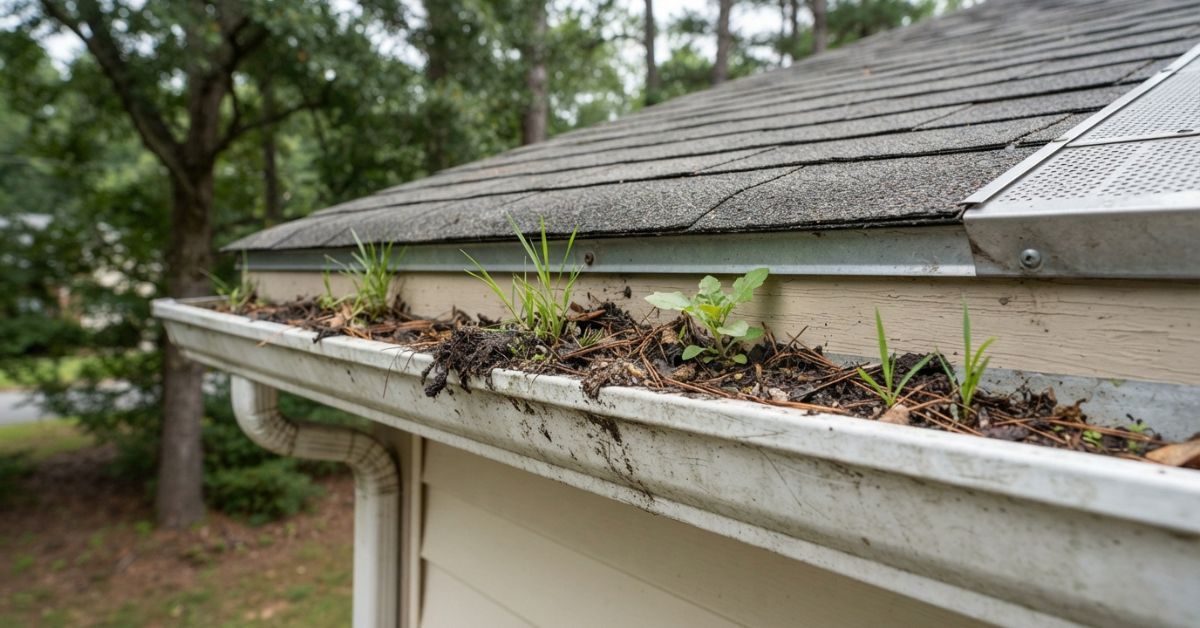
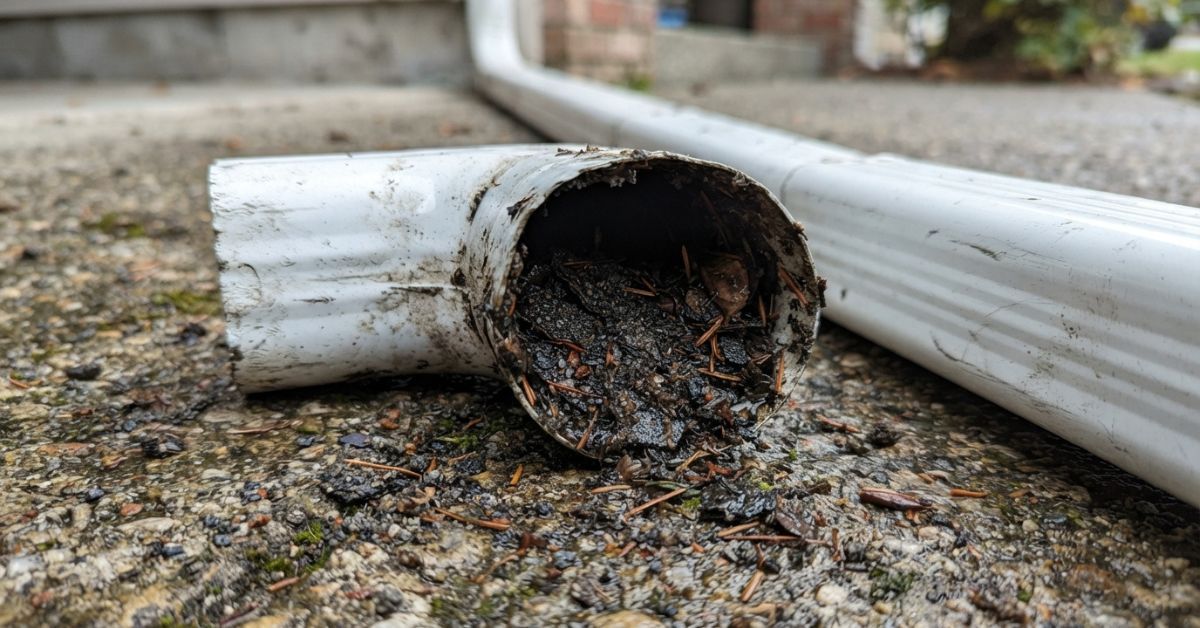
Leaves and needles eat up space in the gutter, and heavy rain fills the rest. Thin metal, too few outlets and loose spikes don't leave much room for both.
Size plays a part too. On a bigger roof, or a house under a lot of trees, a larger gutter with bigger downspouts can give you more breathing room, and that's worth talking about at the estimate.
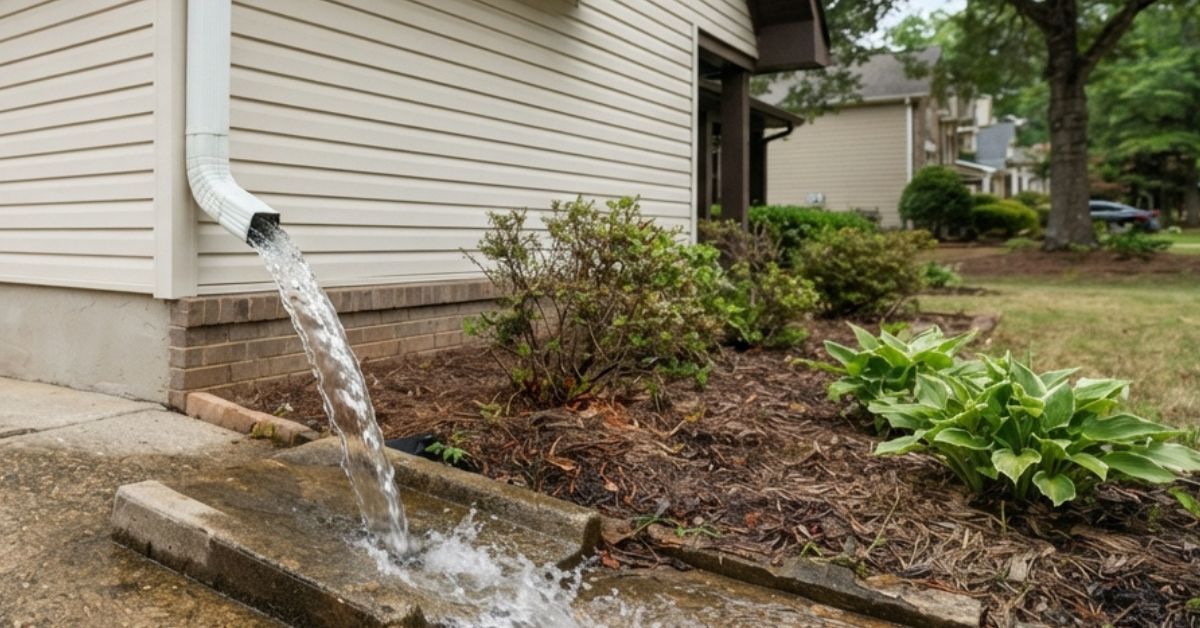
And then there are the sloped lots. Overflow on a hill doesn't soak in, it heads downhill toward the foundation.
Adjusting vs Upgrading Builder-Grade Gutters
You don't always have to tear builder-grade gutters off. It mostly depends on whether the trouble is in a couple of spots or everywhere.
Adjustments Make Sense When
- The gutter material is free of dents and still holds a straight line.
- Only a few spikes have loosened and the fascia behind them is solid.
- Overflow is limited to one spot that an added outlet could relieve.
- The drip edge or apron is in place and doing its job.
An Upgrade Makes Sense When
- Spikes are backing out along most of the run, or the fascia behind them has softened.
- The gutters are dented, wavy, or flex easily.
- Overflow shows up at several points during ordinary storms.
- Water is getting behind the gutter along long stretches of the roofline.
- The roof or fascia is already being replaced and the gutters have to come off anyway.
If it's time to upgrade, that usually means heavier material, hangers fastened into solid wood, more outlets where the roof sends the most water, and proper flashing at the edge.
We roll-form the new gutters right on site to the measured length of each run, so they're built to fit your house.
Deciding What Your Newer Home Needs
Builder-grade doesn't have to mean bad. Plenty of these systems just need a tune-up, and the ones that need replacing usually let you know with repeat overflow, loose spikes, or water getting behind the gutter.
The first step is a simple inspection to see whether adjustments or an upgrade make the most sense for your home. Where several of those signs show up together, our
gutter installation team in Cumming can go over which parts are worth keeping and which are not.
You might also like
Gutters 4 Less Blog